DISCLAIMER | The literary works published by USMO in this article, sourced from Herons’ Flight Magazine Vol. 4: Echo, do not represent the views of the University of Makati, its administrators, staff, or students.
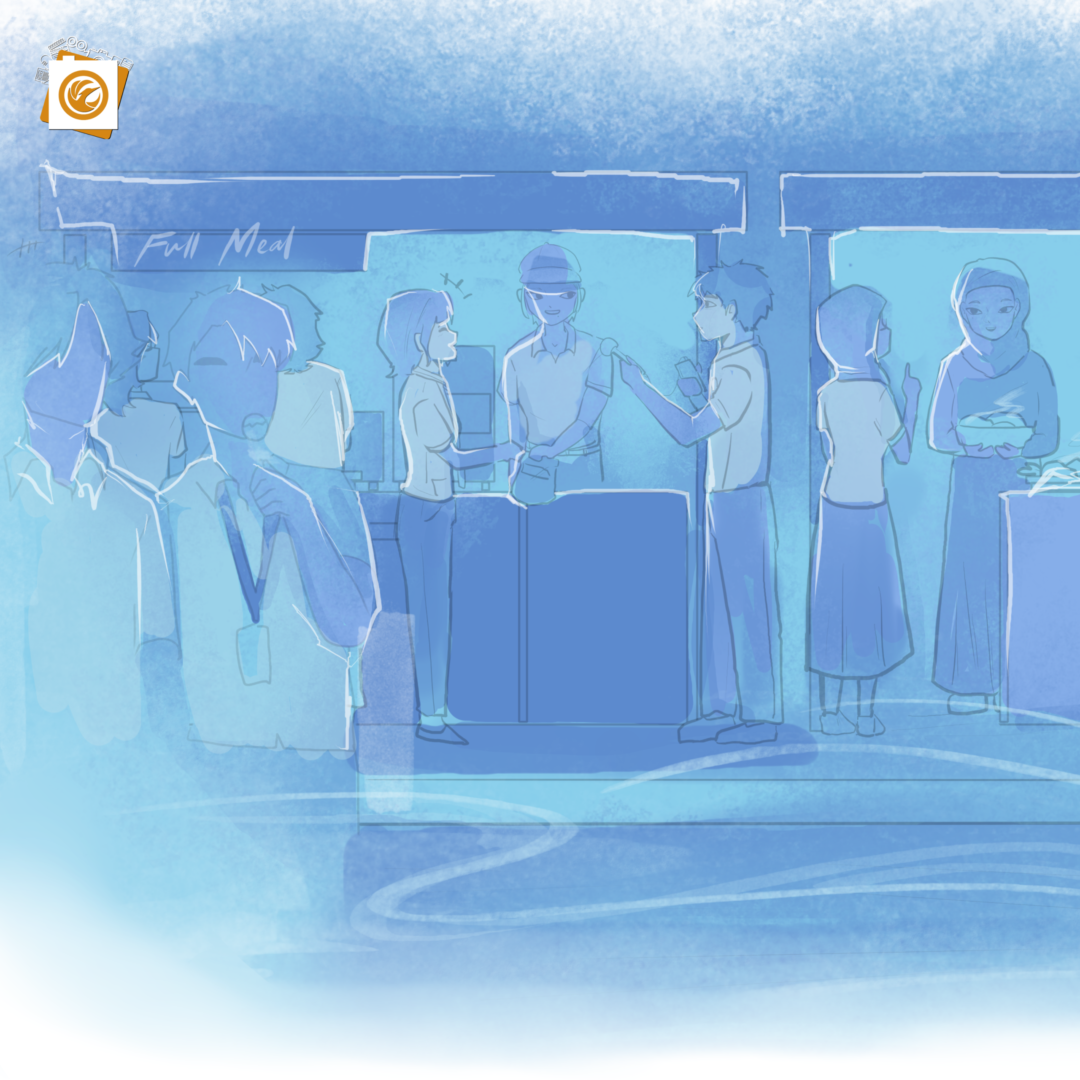
The Manila sun casts golden glares on rooftops, its heat burning through the morning haze. It’s only 6 a.m., and Andy is already zipping up his jacket, adjusting the straps of his new delivery bag as he hops swiftly on his bike. The city is awake — jeepneys ticking with patience as they wait for passengers, and the casual shouts of “Taho!” from the vendors in the distance. There, with a single ting of Andy’s bicycle horn, he joins the river of morning traffic. At 20, he isn’t heading to a campus lecture, unlike his former classmates. Instead, he’s pedaling towards his first delivery of the day.
Andy’s high school friends are now in their second year of college, and their social media posts consist of internship selfies and case study competitions. He sees them all, and he doesn’t mind — not during most days. Sometimes, he can’t help but think if he’s been left behind, while he threads between vehicles to hand out various meals and drinks he carries.
He was supposed to attend college right after graduation, but his father got sick. “We couldn’t afford it. Ganun talaga,” he says offhandedly when people ask why he’s working instead.
For most Filipino families, college is not just expected — it is equated with self-worth, spoken like others talk of salvation. The mindset, “Aangat ka sa buhay ‘pag nakapagtapos ka” has been passed down to children from a young age. Expectations begin from the moment a child brings home a medal. Stitched into school uniforms are pressure in every exam and pride in every report card. Parents pour out everything they have into tuition, because for them, a diploma is not just a piece of paper — it is proof that their struggles have paid off.
For students, the pressure can feel like a constant tug on every step. It’s not just about success but about not being a disappointment. So what happens when a student steps off that path — instead of university papers, they carry heavy loads of cement, a toolbox, or a delivery bag?
Andy stopped checking social media for a while, feelings of being left behind creeping up on him more often than not. He couldn’t bear to see his batchmates’ posts; every ding! from his notifications serves as a reminder that he’s the only one not moving forward. There are nights when he barely gets any sleep, spending them thinking about everything he misses out on.
And yet, his days continue to run like clockwork. The clack of his pedals and the ping! of his apps are the sounds of his daily grind — his schedule barely leaving room to breathe. But even though he’s not in school, he continues to learn all the time. A year on the job has made him memorize the roads, exam codes now exchanged for street names. He learns to hustle, budget his money, make one meal last until dinner.
He often gets asked if he still wants to return, and Andy nods every time. “Of course. Pero baka next year nalang. O sa susunod pa. Hindi muna ngayon.” Little by little, he’s been able to save up for his father’s medicine and just enough to set aside a small fund for himself — maybe for college, maybe for something more.
People might think that there are other ways to get into college, like ‘free tuition’ at state universities. And while it’s true that you don’t have to attend prestigious schools, there are hidden costs that slowly pile up like clutter in a small dorm room — seminar fees, photocopies, transportation, groceries. For students in provinces, simply reaching school can mean walking kilometers or riding boats. So when the pandemic hit, dropout rates surged. Statistics from the Commission on Higher Education (CHED) showed that the attrition rate of universities jumped from 15.90% in school year 2020-2021 to 37.79% in school year 2021-2022 — a clear reflection of how many families had to choose survival over schooling.
Andy has been thinking of taking a short course if he does go back — something in culinary work, maybe in baking, which he hopes will turn into a small business. Lately, he’s been seeing bread-making shows on television, picturing himself owning a business of something he could run from home. For now, he can only imagine the scent of warm pandesal filling their tiny kitchen.
Schools, though, often uphold a single idea of success: Latin honors, certificates, and the dream of walking through the corridors of UP or La Salle. They stress the importance of college entrance exams, but rarely talk about TESDA, side hustles, gap years, or mental health breaks. Their halls are lined with achievement boards, but outside those walls is someone who took a different route — where quiet victories bloomed and thrived in their ways.
A psychologist once said the idea that students must finish college “on time” is also harmful, as it is unrealistic. People experience different circumstances, and people grow at various paces. Some are forced to reroute, while others need to pause. But that doesn’t make them failures. It makes them different. Life just asked for something different.
So, what is success? Is it the honors pinned to a toga? Is it spending your years racing through a degree? Or is it waking up daily with a purpose — even if that purpose is providing help for your family, one delivery at a time?
Back in Manila, Andy clips his helmet back on as another order lights up on his screen. The sun is now high, its light spilling brightly onto the concrete. He swings his leg over his bicycle again and wipes the sweat from his brow. He feels tired but still focused. He delivers a meal right by his old high school, but doesn’t feel bitterness. He might not be wearing a university ID, but he’s still moving and learning. His path is different from the ones on the bulletin board. It’s steeper and sometimes lonely. But it’s his.
And for Andy, that’s what success sounds like: the buzz of his phone notifying a new order, the clink of coins dropping into his savings jar, the soft gulp as he drinks water after a long shift. Such small sounds — but each one holds a life slowly being built. He’s still chasing something of his own, one ride at a time.
Illustrated by Mara Española