DISCLAIMER | The views and opinions expressed by USMO in this article, originally published in Herons’ Flight Magazine Vol. 4: Echo, do not necessarily reflect the views of the University of Makati, its administrators, staff, or students.
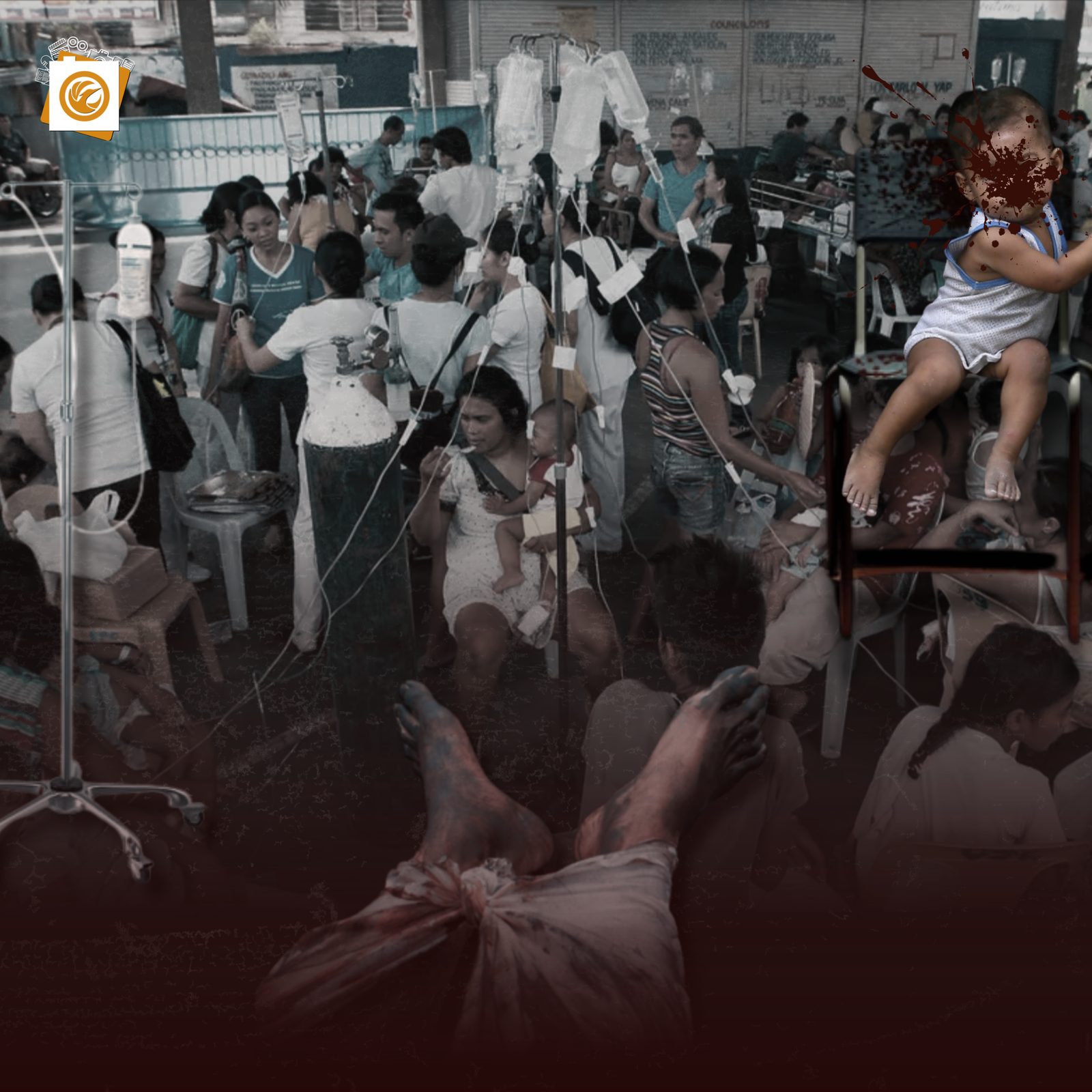
When you enter the emergency ward of a public hospital in the Philippines, what will greet you is not the sound of healing, but the sound of suffering. Improvised emergency rooms are made out of makeshift tents and plastic chairs while some occupy real rooms but are close to bursting due to overcapacity. Healthcare workers struggle to do more with less—until there’s nothing left to give.
But behind those worn-out curtains lies more than a shortage of beds or medicine. It’s the truth that many Filipinos aren’t dying because their illnesses are untreatable—but because the very system meant to save them has failed.
For students in the healthcare field, this reality is no longer just an abstract concept of research. It is witnessed during internships, work immersion, and their supposed duties, where they should be inspired, not discouraged.
As such, these cases were never isolated. They are systemic.
The public healthcare system in the Philippines is in a state of collapse. No amount of policy band-aids can cover up the open wound of neglect. The government must be held accountable for allowing public hospitals—the lifelines for the poor—to become the waiting room for death.
The Department of Health (DOH) data shows that seven in ten Filipinos rely on public healthcare. Yet the government spends less than 3.9% of the country’s Gross Domestic Product (GDP) on health—far below the World Health Organization’s (WHO) 5% recommendation. Even with the Universal Health Care (UHC) law in place in 2019, many PhilHealth members still pay out-of-pocket for basic care, according to the Philippine Institute for Development Studies (PIDS).[1][2][3]
While some can afford swift, specialized care in private hospitals, most are not lucky enough to afford one. One family recounts how, after a sudden illness, they had admitted their child to a private hospital in Alabang with a ₱20,000 deposit. Within hours, specialists were attending to her, and over the week, she received round-the-clock attention in a private room.[4]
However, the public hospital told a different story. Their emergency area was not a proper facility, but only a temporary one. There were not even enough seats to use—so patients sat on the pavement, exposed outside, waiting for care that might come hours later.[4]
This is the cruel divide between the rich and the poor: quality healthcare for the few who can afford it and delayed, inadequate treatment for the latter. In this system, the ability to pay determines comfort but survival.
Public hospitals are overcrowded, understaffed, and underfunded. Many rural ones lack even a single permanent doctor. A study by PIDS in 2023 showed that PhilHealth reimbursements take months to be processed, often forcing hospitals to delay diagnostics or treatments. Meanwhile, healthcare workers are stretched thin—one nurse charges 30 patients per shift. When did healthcare become a thing that people agonize about? How come the system made us choose who will be tended to when healthcare should be for everyone, not only just for some “one”?[5][6][7][8]
Some might argue that the UHC law has already laid the foundation for improvement. Citizens are enrolled in PhilHealth, and there are ongoing infrastructure projects. From a student’s perspective, the problem isn’t access to a health card but what happens after the card is swiped. If there are no medicines, staff, beds, and urgency, then what exactly are patients accessing? What is “coverage” if there is nothing to be covered?
This is the truth that professionals are beginning to confront early in their careers: that despite their training, dedication, and compassion, sometimes, the system is the reason patients don’t make it. And what hurts is that they can only watch their patients as death gnaws the lives out of their helpless bodies. If we continue to train the next generation of health workers without reforming the system they will inherit, we are in for a patient demise.
To change this trajectory, reforms must begin now. The government must significantly increase healthcare funding to support public hospitals and meet the population’s growing demands. In addition, it must hire and retain more healthcare workers by offering fair wages, humane working hours, and meaningful career support. PhilHealth reimbursements must be fast-tracked to prevent critical treatment delays that will cost lives. Infrastructure investments should also extend beyond Metro Manila, focusing on equipping rural and provincial hospitals that have long been left behind.[9][10]
Most importantly, students and young professionals must be included in policy consultations, ensuring that those who inherit the system have a say in rebuilding it. A country’s healthcare system should not be a test of luck—it should be a guarantee. And for the next generation of health workers witnessing this collapse, the call is clear: we must demand better, because our patients deserve better.
If not, more Filipino patients will be stuck in a state of “not sick enough to die—just too poor to live,” abandoned by the very system meant to save them.
Illustrated by Mary Cathyrine Estoque