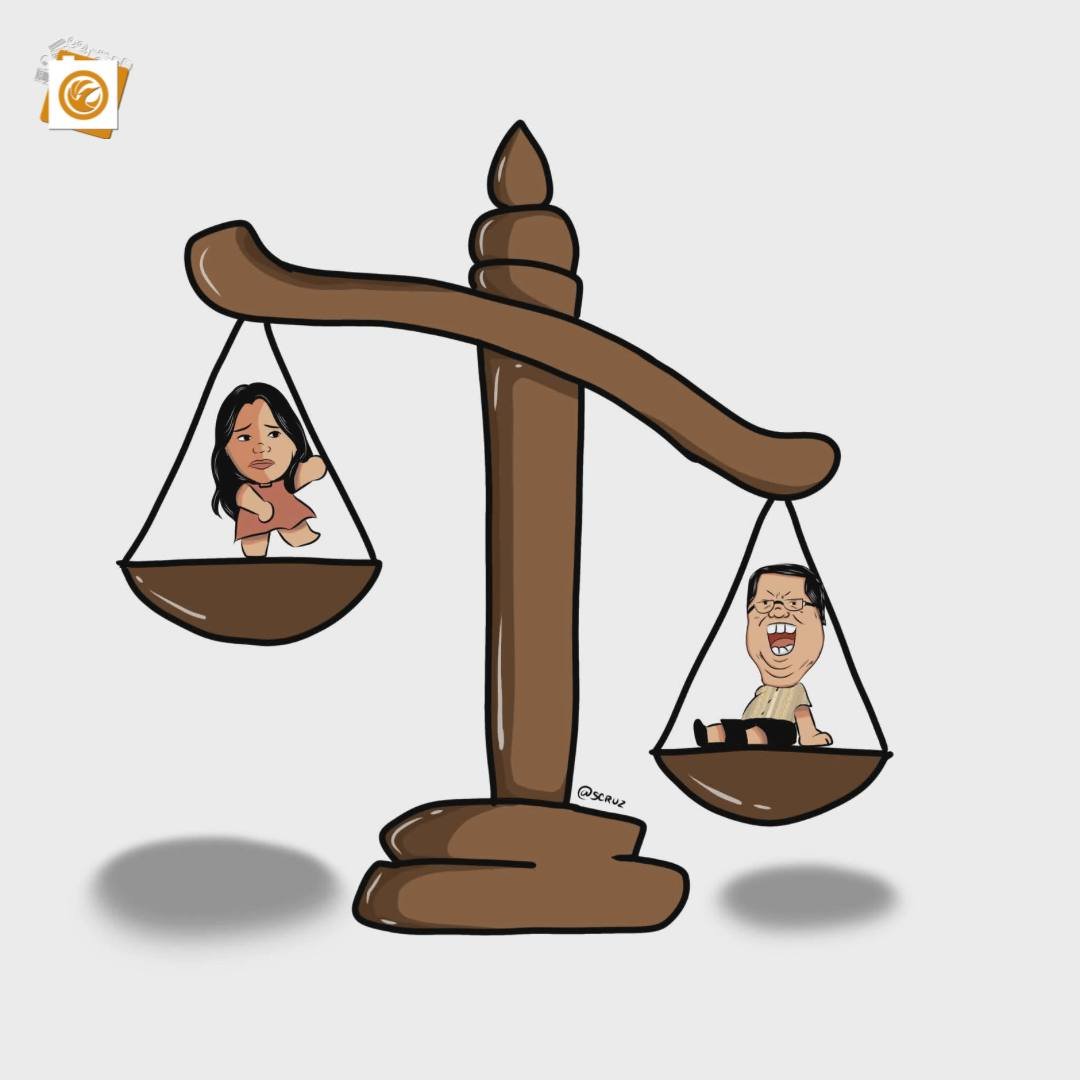
If public officials cannot maintain basic respect inside a justice hearing, the problem is not society being too sensitive. The problem is leaders failing to understand the responsibility that comes with power.
On March 3, during a House Committee on Justice hearing on Vice President Sara Duterte’s impeachment complaint, Quezon City 4th District Representative Jesus Manuel ‘Bong’ Suntay turned a serious discussion into a platform for objectifying actress Anne Curtis. Claiming it was an analogy to defend Duterte’s controversial remark about imagining harm toward President Ferdinand ‘Bongbong’ Marcos Jr., Suntay described a personal thought he had after seeing Curtis in public.
The timing made the offense even sharper: it occurred during Women’s Month, when the country is meant to celebrate women’s rights and achievements. Yet Suntay defended the analogy and even suggested Curtis should take it as a compliment. This act does not only objectify women; it implicitly condones such behavior and grants the rest of the nation the permission to follow—especially as it occurred in a setting meant to cultivate values, respect, and human dignity. Are we to wait for the time the court is filled with men like Suntay?
Everyone must confront a persistent reality: women continue to face objectification, dismissal, and disrespect in both private and public spaces. The controversy surrounding Representative ‘Bong’ Suntay highlights a troubling contradiction. A public official—whose role demands integrity and respect—invoked a sexualized analogy involving actress Anne Curtis during an official congressional hearing.
When a public official reduces a woman to a sexual analogy, especially in a professional and formal setting, the remarks are not merely inappropriate; they reflect a deeper problem in Philippine political culture: the normalization of misogynistic language by those in power. In fact, similar remarks from other political figures show that this problem extends beyond a single incident.
A study by the United Nations Development Programme (UNDP) shows that 99.5% of Filipinos hold biases against women, proving that sexism is deeply rooted in everyday attitudes. The Gender Social Norms Index further reveals that 78% believe men deserve leadership roles more than women, while over 92% justify domestic abuse or restrictions on reproductive rights. Maria Ela Atienza, a political analyst from the University of the Philippines, warns that having women in office is not enough; leaders must actively challenge sexism to break the persistent culture of sexism.
Misogyny in leadership produces real consequences across society. It shapes workplace dynamics, classroom behaviors, social interactions, and policymaking. It pressures women to navigate a society where they face judgment for their appearance, and where their safety and respect are often dismissed. Young men and women receive the message that it is acceptable to objectify women or to brush off inappropriate comments as “humor” or “personality.”
Former President Rodrigo Duterte also repeatedly faced backlash for remarks about women and sexual violence. During the 2016 campaign, he sparked international outrage after joking about the rape and murder of an Australian missionary during a prison riot, saying the mayor should have been first in line, saying: “I was angry because she was raped, that’s one thing. But she was so beautiful, the mayor should have been first, what a waste,” The remark drew laughter from the crowd. Similarly, Senator Robin Padilla has faced criticism for remarks that many saw as undermining women’s autonomy in marriage. During a Senate discussion on sexual consent, Padilla questioned how husbands should respond when their wives refuse intimacy, saying: “You don’t choose when you’re ‘in heat.’ What if your wife doesn’t want to—but you’re in the mood? What are you supposed to do?”
These examples reveal a troubling pattern in Philippine politics. When influential figures speak this way in public, their words carry consequences beyond the moment. Such remarks blur the line between acceptable discourse and misconduct and encourage similar behaviour in political and public spaces.
Beyond all these, the Philippines enforces laws that protect women’s dignity and rights. The Safe Spaces Act prohibits gender-based harassment in streets, workplaces, schools, and online spaces, while the Magna Carta of Women guarantees protection from discrimination and promotes gender equality in public life. These laws establish clear standards of conduct and affirm that women deserve safety, respect, and equal treatment in all spaces. Perhaps due to the lawmakers themselves violating the regulation, citizens get to assume that it is also acceptable for them to bypass it. This should change.
Accountability is crucial. Ethics complaints must be taken seriously, and disciplinary actions—including possible disbarment—should remain on the table.
And as the individuals responsible for vesting these men with authority and power to make policies and governing millions of lives, with women constituting half of its population, allow this and the similar occurrences of disrespecting them be a reminder of how substantial the weight of your singular vote is. Men like Suntay, who belittles the struggle and dismisses women’s dignity do not deserve a seat on that same table.
The timing during Women’s Month amplifies the irony, while society celebrates women’s achievements and rights, public officials still reduce women to sexualized examples in official spaces. Leadership should be measured not only by position, but by the ability to model respect, uphold dignity, and act responsibly. Leaders must be held accountable, and maybe then, can society begin to break the cycle of normalized misogyny and truly foster a culture that respects women and educates the younger generation.
Illustrated by Stephany Cruz
RERERENCES
ABS-CBN Corporation. (2026).
News clip about the Suntay–Anne Curtis controversy. Facebook. https://www.facebook.com/share/v/1BxDbQzDM4/
ABS-CBN Corporation. (2026, March 3).
Rep. Suntay’s remark on Anne Curtis stricken from House panel’s record. https://news.abs-cbn.com/
ABS-CBN Corporation. (2026, March 3).
Rep. Suntay said actress Anne Curtis “should take it as a compliment.” Facebook. https://www.facebook.com/share/p/1a4wKGwkur/
ABS-CBN Corporation. (2026, March 4).
Suntay says sorry “if some people were offended” by “nag-iinit” remark but stands by analogy. Facebook. https://www.facebook.com/share/p/17yTdHx9Do/
GMA Network. (2026, March 4).
Rep. Suntay’s “nag-iinit” remark explained. Facebook. https://www.facebook.com/share/v/18Qpt35WZF/
Hannah Beech. (2019, March 15).
Rodrigo Duterte’s war on women. Time. https://time.com/5549577/rodrigo-duterte-women
PAGEONE Media. (2026, March 4).
House justice panel strikes Rep. Bong Suntay’s Anne Curtis remark from hearingrecord. https://pageone.ph/house-justice-panel-strikes-rep-bong-suntays-anne-curtis-remark-from-hearing-record/
Republic Act No. 11313. (2019).
Safe Spaces Act. https://lawphil.net/statutes/repacts/ra2019/ra_11313_2019.html
Philippine Commission on Women. (n.d.).
Magna Carta of Women. https://pcw.gov.ph/magna-carta-of-women/
Presto, A. C. (2025, July 12).
Misogynistic politics endures in the Philippines despite crackdown. East Asia Forum https://eastasiaforum.org/2025/07/12/misogynistic-politics-endures-in-the-philippines-despite-crackdown
Avendaño, C. O., Yap, D. J., Alconaba, N., & Calleja, N. P. (2016, April 18).
Duterte foes – pounce on mayor’s rape joke. Philippine Daily Inquirer. https://newsinfo.inquirer.net/779986/duterte-foes-pounce-on-mayors-rape-joke
Serato, A. C. (2024, August 17).
Robin Padilla defends “sexual rights” question against critics. PEP.ph. https://www.pep.ph/news/local/182392/robin-padilla-sexual-rights-a718-20240817-lfrm
NewsWatch Plus. (2025, April6).
Misogyny and sexism in current Philippine politics: A battle we can’t ignore. https://www.newswatchplus.ph/2025/04/06/misogyny-and-sexism-in-current-philippine-politics-a-battle-we-cant-ignore/