

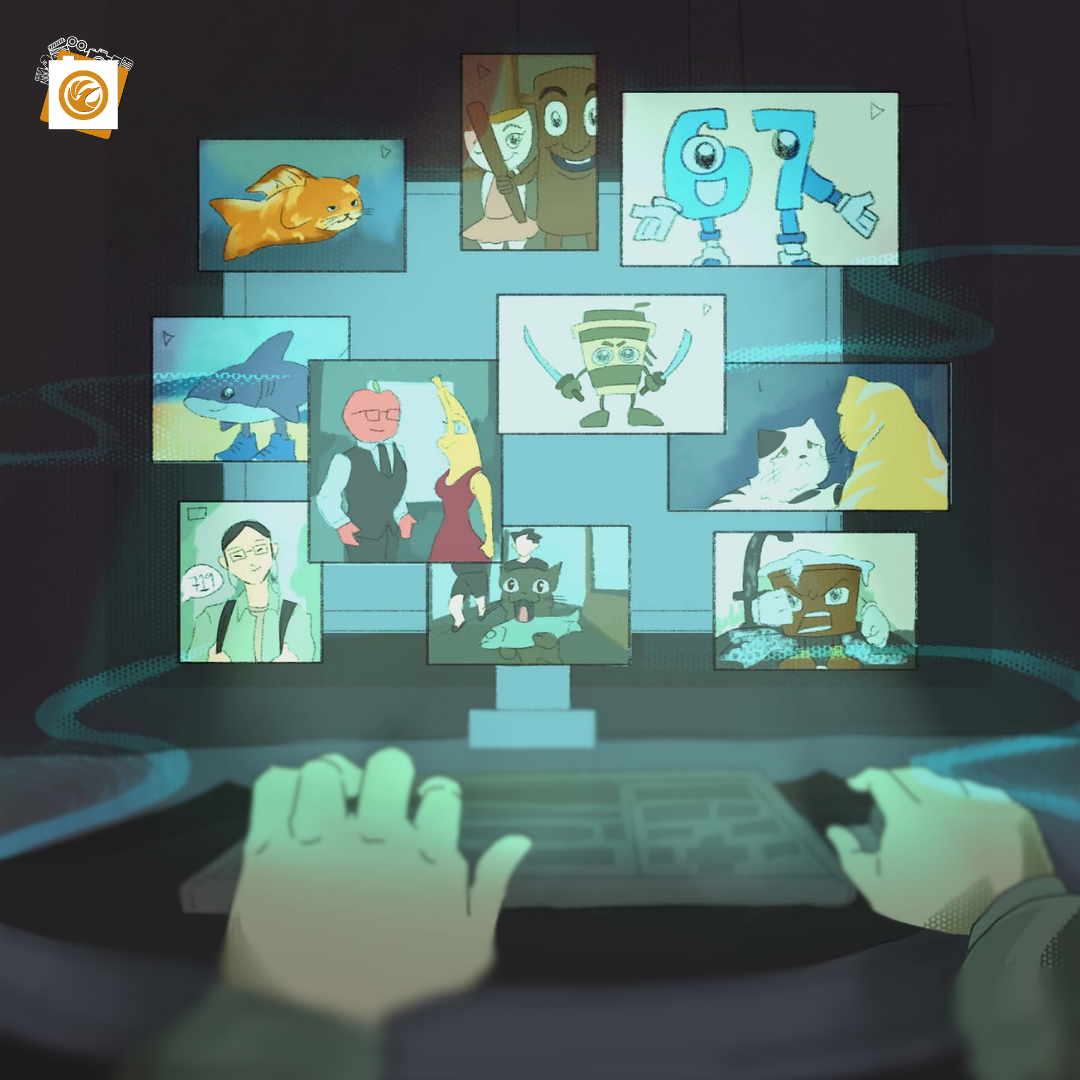
How many times have you opened TikTok or Instagram “just to check something,” only to realize an hour has passed? One swipe turns into a hundred, and suddenly you’re deep in a feed of chaotic memes and oddly catchy sound clips that make little sense, but you can’t stop watching.
Welcome to the age of brainrot.
If names like Skibidi Toilet, Tung Tung Tung Sahur, Ballerina Cappuccino, Tralalelo Tralala, or Chimpanzee Bananini make you nod in recognition, congratulations—you’ve already been exposed. These bizarre, addictive clips dominate feeds and group chats, spreading faster than any traditional trend. But while this content may seem harmless, it raises an important question: Is this chaotic media simply entertainment, or is it reshaping how a generation thinks?
The term brain rot is not new. Henry David Thoreau used it in 1854 in Walden to criticize society’s preference for simple ideas over complex thinking. Fast forward to 2024, when Oxford University Press named it the Word of the Year, defining it as “the supposed deterioration of a person’s mental or intellectual state caused by overconsumption of trivial or unchallenging content, especially online.” Today, brainrot behaviors appear in various forms, such as social media addiction, doomscrolling, zombie scrolling, and excessive gaming.
At first glance, brainrot content seems innocent—sometimes even hilarious or absurd. However, beneath the humor lies a serious concern: constant exposure to rapid, low-effort digital media can train the brain to crave instant gratification while avoiding anything slow, challenging, or intellectually demanding. Mental fog, shrinking attention spans, and difficulty engaging in thoughtful discussions or long-form reading are increasingly common. Philosopher Herbert Marcuse warned decades ago that mass entertainment could create a “one-dimensional” society where depth is replaced by distraction.
This issue is particularly significant in the Philippines, often referred to as the social media capital of the world. According to DataReportal, the country had 90.8 million active social media users in January 2025, representing 78% of the population. Filipinos were also estimated to spend around 3 hours and 32 minutes per day on social media. Meanwhile, a report by Electronics Hub revealed that Filipino children rank among the highest globally in screen time, averaging about 34 hours per week on screens. These figures highlight growing concerns about screen dependency and its potential effects on children’s health and development.
Here’s the kicker: Blaming Generation Alpha alone is absurd. Every generation has had its “mindless” entertainment. Television was once accused of destroying intelligence, while comic books were blamed for distracting children from serious study. But today’s problem is scale and speed. Social media doesn’t just entertain; it overwhelms. Its’ algorithms are engineered to keep users scrolling endlessly, conditioning the brain to expect constant stimulation. Memes, absurd humor, and 15-second videos are not just distractions; they represent a new digital environment built around instant dopamine rewards.
The growing presence of brainrot among young people raises serious concerns about its long-term impact.
Multiple studies highlight the negative effects of excessive digital media consumption, particularly among adolescents and young adults. According to Yousef et al. (2025), prolonged exposure to fragmented digital content can interfere with the brain’s ability to regulate emotions and process information effectively. This is especially concerning for individuals, whose cognitive and emotional regulation skills are still developing. Excessive engagement with digital devices—particularly online media and games—has been linked to increased impulsivity, reduced attention span, and impaired decision-making.
The findings of Yousef et al. (2025) align with research by Zhang et al. (2023), which shows that excessive media use and screen time can lead to cognitive decline, including difficulty concentrating and cognitive overload. Prolonged exposure to online environments may also cause both short- and long-term changes in cognitive functioning.
Additional studies by Nguyen et al. (2025) link heavy consumption of short-form video content to poorer cognitive performance, particularly reduced attention span and impulse control. Research published in Psychological Bulletin also found that excessive viewing of short videos is associated with increased symptoms of depression, anxiety, stress, and loneliness. Similarly, a review of fourteen studies reported links between heavy short-form video use, shorter attention spans, and poorer academic performance (Head, 2025).
While media consumption has its benefits, the education system must adapt to address these challenges. The Department of Education’s consideration of reducing the number of core subjects in senior high school—including the possible removal of Media and Information Literacy—raises serious concerns at a time when digital overconsumption is widespread. If structured media education disappears while students continue to use attention-driven platforms, the consequences could be significant.
The human brain is being rewired by constant digital stimulation. Social media exploits our craving for novelty and connection, delivering small bursts of dopamine with every scroll, tricking our brains into equating endless scrolling with satisfaction, even when we know it’s harmful.
The danger is obvious. When we get used to consuming information in short, shallow bursts, activities that require patience—like reading a book, analyzing complex ideas, or listening to detailed discussions—start to feel uninteresting. Memes and absurd humor are not inherently harmful, but when shallow entertainment dominates daily life, curiosity and critical thinking may gradually decline.
Brainrot isn’t just about viral trends or silly clips; it signals a fundamental shift in how digital habits shape how we think, learn, and engage with the world. Ignore it, and we risk raising a generation that scrolls endlessly but struggles to pause, reflect, or think deeply.
The digital age doesn’t have to equal intellectual decay, but if we keep scrolling blindly, we are cultivating a generation addicted to chaos, incapable of depth, and divorced from true curiosity. That is a crisis we can no longer afford to ignore.
If you don’t take back control now, what kind of brain will you leave for yourself tomorrow?
Illustrated by Remjan Ashley Pimentel
REFERENCES
Arceo, B. (2025.). How Doomscrolling Fuels Brain Rot Among the Youth. Philippine Collegian. https://phkule.org/article/1433/how-doomscrolling-fuels-brain-rot-among-the-youth
Children and Screen Time: Is my child having too much? (2021). Medgate. https://medgate.ph/2021/11/22/children-and-screen-time-is-my-child-having-too-much/
Data Reportal. (2025). Digital 2025: The Philippines. https://datareportal.com/reports/digital-2025-philippines
Gonzales, I. (2024). Brain rot. Philstar.com. https://www.philstar.com/opinion/2024/12/05/2405036/brain-rot
Head, K. R. (2025). Short-form Video Use and Sustained Attention: A Narrative Review (2019–2025). International Journal of Community Empowerment & Society Administration, 2(4), 60-67. https://www.researchgate.net/publication/397712802_Short-form_Video_Use_and_Sustained_Attention_A_Narrative_Review_2019-2025
Heaton, B. (2025). ‘Brain rot’ named Oxford Word of the Year 2024. Oxford University Press. https://corp.oup.com/news/brain-rot-named-oxford-word-of-the-year-2024/
Nguyen, L., Walters, J., Paul, S., et al (2025). Feeds, feelings, and focus: A systematic review and meta-analysis examining the cognitive and mental health correlates of short-form video use. Psychol Bull. 151(9):1125-1146. doi: 10.1037/bul0000498
Thoreau, H. D. (1854). Walden; or, Life in the woods. Ticknor and Fields.
Yousef, A. M. F., Alshamy, A., Tlili, A., & Metwally, A. H. S. (2025). Demystifying the New Dilemma of Brain Rot in the Digital Era: A Review. Brain Sciences, 15(3), 283. https://doi.org/10.3390/brainsci15030283